Anyone who runs, knows or should know, this puts an intense strain on your body. Your feet, legs, back and so on. Some injuries (as detailed here) are easier to get over than others. You should listen to your body and pay attention to what it tells you. The legs feed the wolf. So when your legs start to hurt, and really hurt listen. I have shin splints and thought I would outline what exactly shin splints are, how they feel and what you can do to heal them as quick as possible.
According to healthscout.com shin splints are defined as "Shin splints are characterized by a pain in the front and sides of the lower leg that develops or worsens during exercise. There may also be tenderness over the shin and edema (the accumulation of fluid) of the surrounding tissues. Shin splints are a common problem to runners."
What causes shin splints? There are several ways and reasons but given this is a runners blog I will keep this answer as runner oriented as I can. "Shin splints (an inflammation of tendons and muscles of the shin) is typically brought on by the impact forces of exercise.
The shinbone (or tibia) is covered by the periosteum, a band of soft tissue that has both nerve tissue and a blood supply. Just above the ankle and below the knee, tendons help attach muscles to the periosteum. When the shin is over-stressed, problems can develop in the periosteum, the tendons, the muscle, on the shinbone or in the four muscle compartments of the lower leg, which are covered with a wall of connective tissue (called the fascia). If recurrent, this latter condition is called chronic compartment syndrome.
Shin splints are a common, often seasonal injury that usually occurs when you start to run after a long layoff. They can also result from playing a sport (such as tennis) on a hard surface, changing your style of workout shoes, dramatically increasing workouts, or gaining a substantial amount of weight and then exercising.
Anterior shin splint is due to a muscle or tendon injury (that help to lift the front of the foot) and results in pain and tenderness on the front outside of the leg. Posterior pain (a soreness that radiates along the back and inner side of the lower leg or ankle) is typically caused by stressed muscles that help support and stabilize the arch of the foot."
What can you do to self medicate well at the first sign of pain in the shins, stop your activity. Trying to exercise through the soreness will only aggravate the condition and cause it to worsen.
Immediately massage the area with ice to reduce inflammation and irritation. The ice acts like a quick-acting, anti-inflammatory medication.
For pain relief and help to decrease the swelling, your physician may suggest taking ibuprofen, as directed.Do not apply heat to the area. Shin splints are an inflammatory condition, and heat will only irritate the area even more.
Healing time can be as little as two to three weeks (if you cut back on your exercise and begin aggressive self-help measures), but in some cases, recovery can take as long as 12 to 14 weeks before pain subsides.
So what can you do to prevent shin splints?
Replace or repair exercise shoes that are worn down to the heels. Switch to well-fitting shoes with plenty of impact-absorbing material in the forefoot and heel area. Remember that your running shoes may lose much of their shock absorbency after as few as 500 miles.
Warm up before running by first walking, then gradually increasing your speed to a jog.
When you raise your heart rate and lightly perspire, stop and stretch your calf muscles with a wall stretch. One way to stretch out tight calf muscles and Achilles tendons after warming up is to walk slowly on your heels for 100-200 yards.
Whenever you go for a run or walk, do it on dirt, grass, cinder or a rubberized track to minimize shin trauma.
Sunday, July 27, 2008

Sunday, June 1, 2008
Second Time Around Is Harder Than The First
Hi Everyone,
Miss the blog? If you have you are in luck. I'm back. So it's been just over a month since my last post. I've started training for my second marathon, this time in SF for the Nike Women's Marathon on October 19th. I have to admit I took a week off and then started back into training. Thus far it's been frustrating. I've only been able to run between 4-6 miles. My legs feel like weights and it's humid out now. It's amazing how the conditions can make this more difficult than the first time around. I'm working on resting my legs as much as possible and I have plenty of time to get them back however it's frustrating all the same.
They say to allow yourself 1 day of rest per every mile you run. So 26.2 miles=26/27 days off. I gave myself 10 days. Yeah.
So give yourself sometime, let your body heal and then lace it up. That doesn't mean by the way you can't run during that time, it should be shorter runs however.
So there you go. A quick update! Just keep on running!
Miss the blog? If you have you are in luck. I'm back. So it's been just over a month since my last post. I've started training for my second marathon, this time in SF for the Nike Women's Marathon on October 19th. I have to admit I took a week off and then started back into training. Thus far it's been frustrating. I've only been able to run between 4-6 miles. My legs feel like weights and it's humid out now. It's amazing how the conditions can make this more difficult than the first time around. I'm working on resting my legs as much as possible and I have plenty of time to get them back however it's frustrating all the same.
They say to allow yourself 1 day of rest per every mile you run. So 26.2 miles=26/27 days off. I gave myself 10 days. Yeah.
So give yourself sometime, let your body heal and then lace it up. That doesn't mean by the way you can't run during that time, it should be shorter runs however.
So there you go. A quick update! Just keep on running!
Monday, April 28, 2008
Running My 1st Marathon Experience
So I completed my first marathon. I have to tell you it feels amazing. I know I've talked to most of you since it's happened but I really wanted to do some recaps.
My Time, I honestly had no real care about my "time" whatever i ran would A) be ok and B) would also be a personal best sooo either way win win. But my times and placing are at the bottom.
Overall including half marathon runners there were more than 30,000 participants of those 30,000 only 4373 participated in the full marathon. So what went ... during and after the race? Well here's an idea of the kind of stuff I use during the race:

 My inspiration to run and start training for my second marathon in October
My Time, I honestly had no real care about my "time" whatever i ran would A) be ok and B) would also be a personal best sooo either way win win. But my times and placing are at the bottom.
Overall including half marathon runners there were more than 30,000 participants of those 30,000 only 4373 participated in the full marathon. So what went ... during and after the race? Well here's an idea of the kind of stuff I use during the race:
- peanut butter and a bagel
- water...lots of water
- Gatorade don't just drink water! Replentish the electrolytes!
- Your bib...duh
- Stop watch I use mine to make sure I'm not going too fast out of the gate
- Sunglasses
- Sunscreen
- Your singlet
- Fuel belt, in case you get thirsty before a water/Gatorade station
Here is my time for the marathon, this includes different mile markers as well:
- Full Marathon Time: 5 hours 18 minutes 58 Seconds
- Average mile time: 12 minutes 10 seconds
Time at the following markers:
- 5k: 36:58
- 6 mile: 1:11:44
- 10 mile: 1:58:15
- Half (13.1 miles): 2:37:20
- 20 mile: 4:02:18
In all the experience was unlike any other. Running for that long feeling so totally free of life and problems. There was mental challenges and rough spots along the way, but in all my training was wonderful the coaches and everyone did a great job of prepping us for what laid ahead and honestly I couldn't have imagined preparing for a marathon, especially my first without the coaches. It was incredible. Crossing the finish line, all the reasons I started down the path to running and all the reasons I know now why I am running for rushes to my head and if I could have cried, I would have. I was exhausted mentally & physically at the end. I called 5 people and couldn't compose a decent sentence I don't think, it was overwhelming. I still can't really put into words what it felt like to run 26.2 miles. If you've never run you may not understand it, or what I'm talking about. If you have then you understand. It transcends words and emotions. All I know is I'm excited to run again, excited for another season of TNT and to continue to run for Robert Schultze and his family. I'm sure I'll post a follow up with race pictures soon once they become available. But I really want to send a big thank you and everyone who donated support, effort, energy, time and money. It means the world. Just think, we do it all over again in a month! So if you didn't get a chance to donate...there's another opportunity for you! =o)
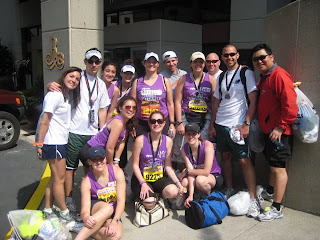
Here are some other photos from my marathon experience:
My inspiration to run and start training for my second marathon in October
Words of encouragement from friends, mentor and my personal everyday inspiration "Silly"

Tuesday, April 22, 2008
Race Anxiety
So I wanted to take a general step back and talk about something I'm experiencing, mostly because I believe most runners, well new runners (I'm not sure if experinced runners get this too) but I will tell you this much it is pretty much the most nerve wracking experience of my life. Why? Not because I don't feel prepared but just the magnitude of running 26.2 miles. It's wild, and crazy to think about. It's always something I've said no way, could never even run to the mailbox to do.
Physically I've lost weight since I started nearly 5 months ago, but I don't feel I look all that different. One thing I've really discovered about running, is that it's truly more mind over matter. That there are points in a race where you have to will yourself to keep going. Yes you have to listen to your body still but there are times where you want to stop and say "fuck it, I can't go on" but it's at that point you have to really dig deep. See running a marathon is more about your mental conditioning as much as it is physical conditioning.
Some tips that I've found VERY comforting. Surround yourself with good supportive people because you will freak out a little, and it's good to have some reassuring friends, drink water and gatorade after all water is good but remember to replace all the things water flushes out, eat right, pasta and carbs are good! =o) Most of all enjoy your experience as you get to the start line look around and remember how far you've come and now all you need to do is go another 26.2 miles. Hey you've done all the hard work, ran step over step and mile over mile. This is just a formaility for you. Enjoy it, bask in the moment because they don't come around very often.
Physically I've lost weight since I started nearly 5 months ago, but I don't feel I look all that different. One thing I've really discovered about running, is that it's truly more mind over matter. That there are points in a race where you have to will yourself to keep going. Yes you have to listen to your body still but there are times where you want to stop and say "fuck it, I can't go on" but it's at that point you have to really dig deep. See running a marathon is more about your mental conditioning as much as it is physical conditioning.
Some tips that I've found VERY comforting. Surround yourself with good supportive people because you will freak out a little, and it's good to have some reassuring friends, drink water and gatorade after all water is good but remember to replace all the things water flushes out, eat right, pasta and carbs are good! =o) Most of all enjoy your experience as you get to the start line look around and remember how far you've come and now all you need to do is go another 26.2 miles. Hey you've done all the hard work, ran step over step and mile over mile. This is just a formaility for you. Enjoy it, bask in the moment because they don't come around very often.
Sunday, March 16, 2008
Knowing When To Listen To Your Body Continued...
Sorry for the delay between posts. But I'm back posting and continuing on with what I promised. More about your injuires and what can be done to help you through them.
This week I'm talking about the Hip Flexor. I just went through a bout with mine so I thought I'd share a bit of my injury and then tell you more about it in general and ways to help yourself heal it and hopefully prevent it!
So three weeks ago I was running hills in Central Park (yes for those of you outside of NY there are rather steep hills in the Park). It was down pouring rain and so the terrain wasn't ideal but as a team we were there to train. As I came down for my last few sets of up and downs on the hill my back started to feel discomfort but it wasn't a terrible pain so I kept running until I got done I didn't realize how bad the pain had become. So I made my way back home and took it easy. The reaminder of the week I noticed I was feeling some discomfort in my hip area, but it wasn't impossible to manage so on Sunday I ran 16 miles. That's when I felt a pain. I was told by my coaches to take the rest of the week off from running as it sounded like a hip flexor strain and to do some stretches to help me with my hip. By the end of the week it felt better adn was able to put in a near 12 mile run pain free on Saturday.
So what happend? When I experienced my back pain, what happend was I started to compinsate in my running form and thus put extra strain on my hip, particularly the hip felxor. The hip flexors are a group of muscles that move the hip forward when running and walking. A great deal of stress is applied to this muscle group when sprinting and kicking.
So what is a hip flexor strain? A hip flexor strain is the result of an overly forceful contraction. This can occur during a sprint or a series of sprints. The strain can also be the result of overuse (kicking/ sprinting) and associated "micro traumas". A micro trauma can be considered a tiny imperceptable tear. These tiny tears accumulate over time and eventually result in a strain and pain. a 1st degree strain involves stretching (or very minor tearing) damage to the muscle or tendon. A 2nd degree strain is associated with partial tearing of the muscle or tendon. And, worst case scenario, a 3rd degree strain is a complete tear. Regarding injury progression, playing with any strain can easily lead to further damage and function loss. This is particularly true when the injury is related to overuse and has a gradual onset. Athletes often try to play through this, with no rehabilitation, and it results in a grade 1 strain becoming a grade 2.
Treatment: As always, ice bags over the painful area for 20-25 minutes after training is a good place to start. Time off from aggravating activities may also be necessary, but this depends on the severity of the injury and when rehabilitation has begun. Athletes with a grade 1 strain can usually continue to participate as tolerated, implementing ice and rehabilitation. Athletes with a grade 2 injury will require some time off and rehabilitation. Time missed can vary from a few days to a few weeks here. Grade 3 hip flexor injuries are rare and will probably be season ending.
This week I'm talking about the Hip Flexor. I just went through a bout with mine so I thought I'd share a bit of my injury and then tell you more about it in general and ways to help yourself heal it and hopefully prevent it!
So three weeks ago I was running hills in Central Park (yes for those of you outside of NY there are rather steep hills in the Park). It was down pouring rain and so the terrain wasn't ideal but as a team we were there to train. As I came down for my last few sets of up and downs on the hill my back started to feel discomfort but it wasn't a terrible pain so I kept running until I got done I didn't realize how bad the pain had become. So I made my way back home and took it easy. The reaminder of the week I noticed I was feeling some discomfort in my hip area, but it wasn't impossible to manage so on Sunday I ran 16 miles. That's when I felt a pain. I was told by my coaches to take the rest of the week off from running as it sounded like a hip flexor strain and to do some stretches to help me with my hip. By the end of the week it felt better adn was able to put in a near 12 mile run pain free on Saturday.
So what happend? When I experienced my back pain, what happend was I started to compinsate in my running form and thus put extra strain on my hip, particularly the hip felxor. The hip flexors are a group of muscles that move the hip forward when running and walking. A great deal of stress is applied to this muscle group when sprinting and kicking.
So what is a hip flexor strain? A hip flexor strain is the result of an overly forceful contraction. This can occur during a sprint or a series of sprints. The strain can also be the result of overuse (kicking/ sprinting) and associated "micro traumas". A micro trauma can be considered a tiny imperceptable tear. These tiny tears accumulate over time and eventually result in a strain and pain. a 1st degree strain involves stretching (or very minor tearing) damage to the muscle or tendon. A 2nd degree strain is associated with partial tearing of the muscle or tendon. And, worst case scenario, a 3rd degree strain is a complete tear. Regarding injury progression, playing with any strain can easily lead to further damage and function loss. This is particularly true when the injury is related to overuse and has a gradual onset. Athletes often try to play through this, with no rehabilitation, and it results in a grade 1 strain becoming a grade 2.
Treatment: As always, ice bags over the painful area for 20-25 minutes after training is a good place to start. Time off from aggravating activities may also be necessary, but this depends on the severity of the injury and when rehabilitation has begun. Athletes with a grade 1 strain can usually continue to participate as tolerated, implementing ice and rehabilitation. Athletes with a grade 2 injury will require some time off and rehabilitation. Time missed can vary from a few days to a few weeks here. Grade 3 hip flexor injuries are rare and will probably be season ending.
Monday, February 18, 2008
Knowing When to Listen to Your Body
A key part of running is knowing how to listen to your body. When it's time to slow down, speed up, continue to run through pain and when to stop. You may not know at first what's small aches and pains you can run through and what you should stop yourself before it gets too serious. Every person is a bit different. For me I experience a pain in my knee it's not an overwhelming pain but I can definitely feel it as I run. But I've gotten used to having this small twitch in my knee (usually it's my left knee). Where as when I started to run early on with a wrong pair of shoes I had a pain on my Achilles. Turns out after resting it for two weeks it was totally fine again however if I had kept running on it, I could have done some long term harm. There are some knee injuries that are there but aren't long term and are more about conditioning your body to getting used to running. Today I will focus on some common knee pains you may incur early on. According to coolrunning.com some typical knee pains will include:
Runners knee: This occurs when your body get around 40 miles a week if it's never run before you will experience these pains around your knee cap area sometimes behind your knee cap. Even after taking a few days off, the pain seems to come right back, sometimes even intensifying, after the first few miles of the next run. The pain often feels worst when running downhill or walking down stairs. The test for runner's knee: sit down and put your leg out on a chair so that it's stretched out straight. Have a friend squeeze your leg just above the knee while pushing on the kneecap. Have your friend push from the outside of the leg toward the center. At the same time, tighten your thigh muscle. If this is painful, you've got runner's knee.
Iliotibial Band Syndrome: Pain on the outside of your knee (not usually accompanied by swelling or locking). The pain may be sporadic and disappear with rest, only to reoccur suddenly, often at the same point in a run. Depending on the individual, this could happen at four miles, two miles or just 200 yards. The pain often goes away almost immediately after you stop running. The cause is that this is an overuse injury. The iliotibial band is a band of tissue that begins at the outside of the pelvis and extends to the outside part of the knee. The band helps stabilize the knee. If it becomes too short, the band rubs too tightly on the bone of your leg and becomes irritated. The tightness is usually the result of too much strain from over training. So what you can do to prevent or reduce this? Patience. This one takes a while. Give yourself plenty of rest, reduce your miles and ice frequently. You can keep running, but cut your run short as soon as you begin to feel any pain. Cut way back on hill work, and be sure to run on even surfaces. Look into some deep friction massage with a physical therapist. Patience. This one takes a while. Give yourself plenty of rest, reduce your miles and ice frequently. You can keep running, but cut your run short as soon as you begin to feel any pain. Cut way back on hill work, and be sure to run on even surfaces. Look into some deep friction massage with a physical therapist.
You will typically have an instinct on when you need to slow down your running and what's acceptable pain. If you are at all like me, who's never really run before (regardless of body type) start with smaller mileage, go at your own pace and don't worry about mile times. You should enjoy your running. It's meant to be fun, and a way for you to do something for you. Next week I'll focus on other types of injuries you can face, but for now this is a good spot to begin. Remember run and have fun but go at a good pace for you, not what your friends can do, and listen to your body!
Doc
Runners knee: This occurs when your body get around 40 miles a week if it's never run before you will experience these pains around your knee cap area sometimes behind your knee cap. Even after taking a few days off, the pain seems to come right back, sometimes even intensifying, after the first few miles of the next run. The pain often feels worst when running downhill or walking down stairs. The test for runner's knee: sit down and put your leg out on a chair so that it's stretched out straight. Have a friend squeeze your leg just above the knee while pushing on the kneecap. Have your friend push from the outside of the leg toward the center. At the same time, tighten your thigh muscle. If this is painful, you've got runner's knee.
Iliotibial Band Syndrome: Pain on the outside of your knee (not usually accompanied by swelling or locking). The pain may be sporadic and disappear with rest, only to reoccur suddenly, often at the same point in a run. Depending on the individual, this could happen at four miles, two miles or just 200 yards. The pain often goes away almost immediately after you stop running. The cause is that this is an overuse injury. The iliotibial band is a band of tissue that begins at the outside of the pelvis and extends to the outside part of the knee. The band helps stabilize the knee. If it becomes too short, the band rubs too tightly on the bone of your leg and becomes irritated. The tightness is usually the result of too much strain from over training. So what you can do to prevent or reduce this? Patience. This one takes a while. Give yourself plenty of rest, reduce your miles and ice frequently. You can keep running, but cut your run short as soon as you begin to feel any pain. Cut way back on hill work, and be sure to run on even surfaces. Look into some deep friction massage with a physical therapist. Patience. This one takes a while. Give yourself plenty of rest, reduce your miles and ice frequently. You can keep running, but cut your run short as soon as you begin to feel any pain. Cut way back on hill work, and be sure to run on even surfaces. Look into some deep friction massage with a physical therapist.
You will typically have an instinct on when you need to slow down your running and what's acceptable pain. If you are at all like me, who's never really run before (regardless of body type) start with smaller mileage, go at your own pace and don't worry about mile times. You should enjoy your running. It's meant to be fun, and a way for you to do something for you. Next week I'll focus on other types of injuries you can face, but for now this is a good spot to begin. Remember run and have fun but go at a good pace for you, not what your friends can do, and listen to your body!
Doc
Monday, February 11, 2008
These aren't gimmicks
I used to always doubt products that claimed they rejuvenated or added something to your body during workouts. I always thought they were claims (and yes being in advertising I know there's always certain hype behind products). Two products that I've found to be of great help during my first half marathon this weekend were the following 1) Gatorade and 2) Under Armor.
I'll start with Gatorade. Along the way of running any race from 4-5 miles up to a full marathon there are water stations along the way. There are also Gatorade (at least during my event) as well. When I got to the first water station I grabbed two cups of water (new runners practice grabbing two cups between your index and middle finger and your pinky and ring finger, then take one cup and squeeze the top so it makes a funnel and then you can control your water intake). Anyway I grabbed the water and only water and downed it and kept running. Early in the race you should have enough energy where it won't matter as much what you drink, just as long as you keep yourself hydrated. By the second water station I saw the Gatorade and grabbed one Gatorade cup and one water. Drank them both pretty quickly. Third water station I grabbed only Gatorade drank both of them. I did start to feel energy returning. Gatorade returns electrolytes and carbohydrates. See what happens during a longer run is towards the back half of your run, your body runs out of carbs and electrolytes to burn. So what does it burn? Muscle. That's not good. So it's why they created those gels and blocks (as I mentioned in my last post) definitely have at least one if not two of those ready for your half. You'll need it. Another thing about Gatorade or sports drinks in general is a study that was released from Medicine & Science in Sports & Exercise that concluded, "athletes can stave off fatigue 37% longer if they drink sports drinks -- the kind with electrolytes and carbohydrates in them. They also run faster, have better motor skills, and are mentally sharper"
What you will want to avoid, on the flip side, are caffeine drinks. Soft drinks don't really replenished anything the body needs so if it's not going to help, why add it? it won't help and during a race/half marathon/full marathon it's all about efficiency in your body SO add things that will add that and not take away or have no effects.
Under Armor. Ok we've all seen the ads, buff athletes yelling and screaming wearing what appears to be spandexish clothes. Now I bought two under armor shirts for $40 each. Yeah they are expensive but I have not even once regretted buying them. One thing it does is keep your body heat in. This is key as a runner. A runner will heat up about 10 degrees during a run, and if you start training in the winter it's important to keep that heat in, in addition it does a good job of keeping the sweat in as well. I sweat a lot when I run but under armor does a superior job of keeping me drier and my body heat in. Even during hotter runs you want to pay attention to your body, the beauty of Under Armor is that in heat it keeps you regulated better than a T-shirt or a sweatshirt. It's definitely worth the investment in a pair or two. I'll break down Under Armor for you as they have different types of things for different types of weather:
ColdGear is Under Armour's most technical line featuring a double sided fabric that wicks moisture from the skin and circulates body heat. ColdGear provides warmth without weight for long days in the field.
HeatGear is engineered with a microfiber blend fabric featuring the signature Moisture Transport System and reliable compression. It's designed to fit tight to your skin, under your outerwear.
LooseGear gives moisture management and core temperature regulation in a generous cut for comfort. The ultimate solution: LooseGear, features the signature Moisture Transport System in lightweight microfiber blend.
If you are going to train in the winter do so the right way. It's all about efficiency so invest in the things that will make you more efficient.
Catch you next week!
Doc
I'll start with Gatorade. Along the way of running any race from 4-5 miles up to a full marathon there are water stations along the way. There are also Gatorade (at least during my event) as well. When I got to the first water station I grabbed two cups of water (new runners practice grabbing two cups between your index and middle finger and your pinky and ring finger, then take one cup and squeeze the top so it makes a funnel and then you can control your water intake). Anyway I grabbed the water and only water and downed it and kept running. Early in the race you should have enough energy where it won't matter as much what you drink, just as long as you keep yourself hydrated. By the second water station I saw the Gatorade and grabbed one Gatorade cup and one water. Drank them both pretty quickly. Third water station I grabbed only Gatorade drank both of them. I did start to feel energy returning. Gatorade returns electrolytes and carbohydrates. See what happens during a longer run is towards the back half of your run, your body runs out of carbs and electrolytes to burn. So what does it burn? Muscle. That's not good. So it's why they created those gels and blocks (as I mentioned in my last post) definitely have at least one if not two of those ready for your half. You'll need it. Another thing about Gatorade or sports drinks in general is a study that was released from Medicine & Science in Sports & Exercise that concluded, "athletes can stave off fatigue 37% longer if they drink sports drinks -- the kind with electrolytes and carbohydrates in them. They also run faster, have better motor skills, and are mentally sharper"
What you will want to avoid, on the flip side, are caffeine drinks. Soft drinks don't really replenished anything the body needs so if it's not going to help, why add it? it won't help and during a race/half marathon/full marathon it's all about efficiency in your body SO add things that will add that and not take away or have no effects.
Under Armor. Ok we've all seen the ads, buff athletes yelling and screaming wearing what appears to be spandexish clothes. Now I bought two under armor shirts for $40 each. Yeah they are expensive but I have not even once regretted buying them. One thing it does is keep your body heat in. This is key as a runner. A runner will heat up about 10 degrees during a run, and if you start training in the winter it's important to keep that heat in, in addition it does a good job of keeping the sweat in as well. I sweat a lot when I run but under armor does a superior job of keeping me drier and my body heat in. Even during hotter runs you want to pay attention to your body, the beauty of Under Armor is that in heat it keeps you regulated better than a T-shirt or a sweatshirt. It's definitely worth the investment in a pair or two. I'll break down Under Armor for you as they have different types of things for different types of weather:
ColdGear is Under Armour's most technical line featuring a double sided fabric that wicks moisture from the skin and circulates body heat. ColdGear provides warmth without weight for long days in the field.
HeatGear is engineered with a microfiber blend fabric featuring the signature Moisture Transport System and reliable compression. It's designed to fit tight to your skin, under your outerwear.
LooseGear gives moisture management and core temperature regulation in a generous cut for comfort. The ultimate solution: LooseGear, features the signature Moisture Transport System in lightweight microfiber blend.
If you are going to train in the winter do so the right way. It's all about efficiency so invest in the things that will make you more efficient.
Catch you next week!
Doc
Subscribe to:
Posts (Atom)


 Posts
Posts


